In a research environment where a single percentage point of impurity can invalidate months of metabolic data, the distinction between a generic compound and a verified semaglutide 5mg research peptide is the difference between scientific progress and wasted resources. You likely recognize that as the global GLP-1 market reaches an estimated $68.65 billion in 2026, the influx of unverified materials has made laboratory procurement increasingly complex. The challenge isn’t just finding a supplier; it’s ensuring the structural integrity of the compound matches its theoretical profile.
This technical analysis provides the clarity you need to verify molecular integrity and ensure your research protocols remain grounded in objective data. We’ll examine the specific chemical properties of the 5mg lyophilized vial, interpret the nuances of HPLC and mass spectrometry reports, and establish standardized handling procedures. By the end of this overview, you’ll have a clear framework for evaluating batch consistency and maintaining the stability of your research samples.
Key Takeaways
- Analyze the molecular architecture of the semaglutide 5mg research peptide, focusing on how specific amino acid substitutions at position 8 enhance its stability for metabolic study.
- Identify the primary research applications for this GLP-1 analogue within endocrine models, specifically its impact on insulin secretion and glucagon suppression.
- Learn to interpret High-Performance Liquid Chromatography (HPLC) chromatograms and Mass Spectrometry reports to verify batch-specific purity and molecular weight.
- Master the technical requirements for aseptic reconstitution and long-term storage of lyophilized compounds to prevent chemical degradation.
- Establish a framework for verifying structural integrity, ensuring that laboratory reagents meet the rigorous standards required for reproducible research outcomes.
Understanding Semaglutide 5mg as a Synthetic GLP-1 Analogue
Semaglutide is a synthetic analogue of the naturally occurring peptide hormone Glucagon-Like Peptide-1 (GLP-1). It functions as a long-acting GLP-1 receptor agonist (GLP-1RA). In metabolic research, the semaglutide 5mg research peptide is utilized to investigate physiological responses related to incretin system pathways. Unlike native GLP-1, which has a half-life of roughly two minutes due to rapid degradation by the enzyme dipeptidyl peptidase-4 (DPP-4), this synthetic variant is engineered for extended stability. This chemical durability allows researchers to observe sustained biological interactions that were previously difficult to track with short-acting compounds.
Strict adherence to legal and procedural boundaries is mandatory. This compound carries a “Research Use Only” designation, meaning it’s not for human consumption, veterinary use, or any form of clinical application. Maintaining this boundary is a mark of professional integrity in the scientific community. It ensures that laboratory experiments remain isolated from medical practice, preserving the objectivity of the data collected. Standardized 5mg vials provide a reliable benchmark for laboratory settings. This specific mass allows for precise dilution and dosing across various test models, offering a balance between sufficient material for longitudinal data and the stability required for meticulous handling.
The Evolution of GLP-1 Research Compounds
The history of metabolic research reflects a methodical shift from short-acting peptides to more durable Semaglutide GLP-1 Analogue variants. Initial studies focused on native GLP-1, but its rapid clearance made it difficult to observe sustained receptor-mediated responses. Researchers required a compound that could resist enzymatic breakdown to understand chronic metabolic modulation. The semaglutide 5mg research peptide is currently a primary focus in endocrine investigation. Its structural modifications allow it to remain active for a significantly longer duration than its predecessors, providing a clearer window into how synthetic peptides influence receptor-mediated signaling over time.
Lyophilization: Preserving Molecular Integrity
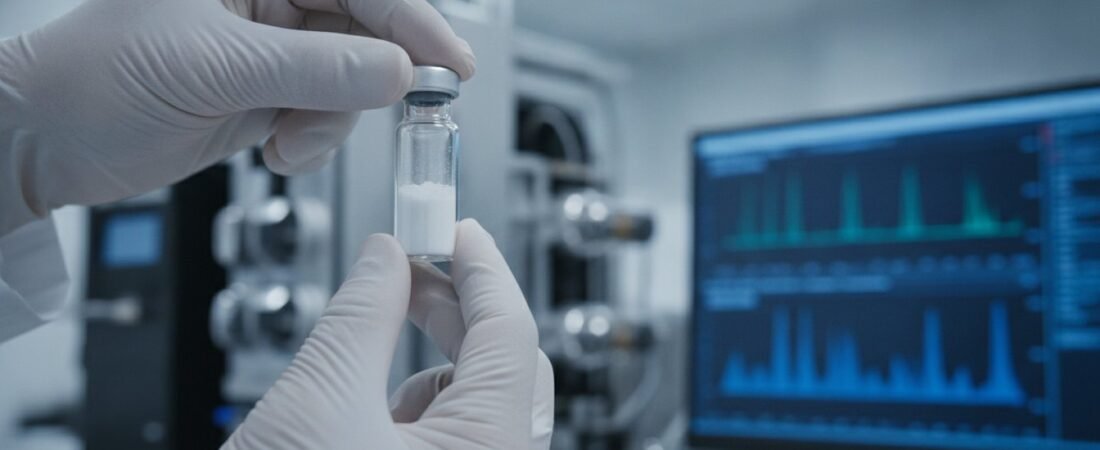
To maintain chemical stability, the 5mg vials undergo a process known as lyophilization. This freeze-drying technique removes moisture while the peptide is in a frozen state, which prevents the hydrolytic degradation that often occurs in liquid solutions. It’s a critical step for ensuring long-term stability during transport and storage. A high-quality batch typically presents as a uniform, white, crystalline cake. If you observe a collapsed or discolored structure within the vial, it may indicate moisture ingress or compromised molecular integrity. This specialized lyophilized format is essential for researchers who require consistent, reproducible results across different experimental batches.
Chemical Structure and Molecular Specifications of Semaglutide
The molecular architecture of the semaglutide 5mg research peptide is defined by its specific chemical formula, C187H291N45O59, and a molecular weight of approximately 4113.6 g/mol. To understand its behavior in laboratory models, one must look at the structural modifications that distinguish it from human GLP-1. These alterations aren’t merely aesthetic; they’re functional engineering choices designed to overcome the rapid metabolic clearance that characterizes native peptides. The Chemical Structure and Molecular Specifications of Semaglutide reveal a sequence that’s been strategically reinforced at key vulnerable sites to ensure stability during in vitro trials.
The most significant modification occurs at position 8. In native GLP-1, this position is occupied by alanine, which is the primary target for the dipeptidyl peptidase-4 (DPP-4) enzyme. By substituting alanine with alpha-aminoisobutyric acid (Aib), the peptide becomes resistant to enzymatic cleavage. This resistance is a cornerstone of the compound’s long-acting profile. Additionally, the attachment of a C18 fatty diacid side chain via a gamma-glutamic acid linker at position 26 facilitates strong non-covalent binding to albumin. This acylation ensures the compound remains in circulation within test environments for extended periods, providing a durable ligand for receptor study.
Amino Acid Sequence and Substitutions
The replacement of alanine with Aib at position 8 provides a steric hindrance that prevents DPP-4 from recognizing the cleavage site. This single substitution radically alters the peptide’s metabolic fate. Along with this, the acylation of Lysine 26 allows the peptide to bind to albumin proteins. This mechanism effectively reduces renal clearance and protects the peptide from further degradation. In model systems, these changes extend the half-life significantly, allowing researchers to observe biological effects over a seven-day cycle rather than a few minutes. For those conducting these detailed trials, sourcing a high-purity semaglutide 5mg research peptide is essential for achieving data accuracy.
Receptor Affinity and Binding Mechanisms
In vitro, semaglutide acts as a potent GLP-1 receptor agonist. Its high affinity for the GLP-1 receptor is maintained despite the bulky fatty acid side chain. The structural basis for this affinity lies in the preserved N-terminal region, which is critical for receptor activation. When the peptide binds to its target, it triggers a conformational change in the receptor, initiating intracellular signaling pathways. Purity is a non-negotiable factor here. Even minor impurities or truncated sequences can interfere with binding kinetics, leading to inconsistent results in metabolic assays. High-resolution analytical testing ensures that the ligand interacting with the receptor is chemically identical to the intended sequence.
Research Applications: Metabolic and Endocrine Study Models
The utility of the semaglutide 5mg research peptide extends beyond simple glycemic observation; it serves as a precise instrument for mapping complex endocrine interactions. Researchers utilize this synthetic analogue to quantify dose-dependent insulin secretion from pancreatic beta-cells under various glucose concentrations. By suppressing glucagon release from alpha-cells, the compound allows for a controlled study of hepatic glucose production. These mechanisms are fundamental to understanding how incretin mimetics restore homeostatic balance in metabolic models.
In animal models, investigators use the peptide to explore the central nervous system’s role in energy regulation. The compound’s stability allows for longitudinal studies on gastric emptying rates and the activation of satiety-related neurons within the hypothalamus. By maintaining a consistent concentration through the 5mg lyophilized format, laboratories ensure that observed variations in satiety signaling result from experimental variables rather than batch instability. This consistency is vital for researchers who need to produce reproducible data in weight regulation studies.
Beyond traditional metabolic markers, the compound is increasingly used to investigate neuroprotective properties. Current studies in rodent models focus on its ability to modulate neuroinflammation and enhance synaptic plasticity. These applications suggest that the GLP-1 receptor’s influence reaches far beyond the gut and pancreas. This expanding scope of research requires reagents that maintain structural integrity over the course of extended experimental timelines.
In Vitro Signaling Pathways
In cell culture environments, the primary focus is often on intracellular signaling. The activation of the GLP-1 receptor by the semaglutide 5mg research peptide triggers the production of cyclic adenosine monophosphate (cAMP). This secondary messenger provides a measurable readout for ligand potency. Researchers also use these models to track GLP-1 receptor internalization kinetics and observe beta-cell proliferation. Such granular data is essential for understanding the long-term cellular effects of sustained receptor agonism.
Comparative Research with Other Incretin Mimetics
The value of this compound as a baseline in comparative studies is significant. While newer agents act as dual agonists at both the GLP-1 and GIP receptors, semaglutide provides a highly selective GLP-1 signal. This selectivity is vital for isolating the specific biological contributions of the GLP-1 pathway without the confounding variables introduced by multi-receptor activation. For a more detailed analysis of these differences, researchers often reference a Semaglutide vs Tirzepatide Comparison to determine which reagent best aligns with their specific experimental design. Using a well-characterized selective agonist ensures that the data collected remains focused on a single, clear metabolic pathway.
Verifying Purity: Interpreting HPLC and Mass Spectrometry
High-Performance Liquid Chromatography (HPLC) is the indispensable gold standard for determining the purity of a semaglutide 5mg research peptide. This analytical method separates the chemical components of a sample based on their interactions with a stationary phase and a mobile phase. When you examine a chromatogram, the primary peak represents the target compound. Any smaller peaks, or “shoulders” on the main peak, indicate the presence of impurities or degradation products. For metabolic research to remain valid, the target peak must account for at least 99% of the total area to prevent off-target effects that could compromise your data.
While HPLC confirms purity, Mass Spectrometry (MS) is required to confirm the identity of the molecule. MS measures the mass-to-charge ratio of ions to determine the exact molecular weight of the sample. For semaglutide, the resulting data should align with the theoretical molecular weight of approximately 4113.6 g/mol. Without this confirmation, a researcher can’t be certain that the high-purity peak identified by HPLC is actually the intended peptide sequence. Together, these tests provide a complete chemical profile that ensures the reagent’s structural integrity.
Analyzing the Certificate of Analysis (COA)
A Certificate of Analysis (COA) provides the documented proof of these analytical tests. When you review a COA for the semaglutide 5mg research peptide, several key metrics require your attention:
- Purity: The percentage of the target peptide relative to other substances, typically determined by the Area Under the Curve (AUC) in an HPLC report.
- Net Peptide Content: This value represents the actual weight of the peptide in the vial, excluding water and counter-ions like acetate.
- Acetate Content: Peptides are often synthesized as acetate salts; this value quantifies the residual acetate.
Always verify that the batch number on the vial matches the testing report. Cross-referencing the test date ensures the data is current and relevant to the specific lot in your laboratory. This verification step is a fundamental aspect of professional laboratory procurement.
Identifying Common Impurities
Impurities in synthetic peptides often stem from the manufacturing process. Residual solvents or high levels of trifluoroacetic acid (TFA) can interfere with cellular assays or cause unexpected results in animal models. Truncated peptide sequences, which occur when amino acids fail to attach during synthesis, are particularly problematic. These deletion sequences may still bind to receptors but lack the full biological activity of the complete molecule, leading to skewed data. ABetterLife Peptides ensures batch-to-batch consistency by subjecting every lot to rigorous third-party HPLC and MS verification. If you require reagents with verified structural integrity, you can view HPLC-tested semaglutide 5mg vials to ensure your study meets the highest analytical standards.
Laboratory Handling, Reconstitution, and Storage Protocols
Handling the semaglutide 5mg research peptide requires a meticulous approach to prevent mechanical or thermal degradation. While the lyophilized powder is robust, its structural integrity is vulnerable once it transitions into a liquid state. Professional storage for the dry form should occur at -20°C for long-term preservation; however, refrigeration at 2-8°C is acceptable for immediate use. Safety is paramount. Always utilize appropriate personal protective equipment, including gloves and eye protection, when working with concentrated research-grade chemicals within a sterile environment. This ensures both the safety of the researcher and the purity of the sample.
Maintaining an aseptic environment during the reconstitution process ensures that microbial contamination doesn’t interfere with your experimental outcomes. This involves sanitizing the vial stopper and the diluent container with 70% isopropyl alcohol before any needle entry. Once the compound is in solution, its stability becomes a function of temperature and light exposure. Researchers should prioritize consistency in their handling logs to track the age and storage conditions of every vial used in a trial. Precise record-keeping is a hallmark of high-integrity laboratory practice.
Standard Reconstitution Procedure
For most laboratory applications, bacteriostatic water or sterile 0.9% saline serves as the primary diluent. To achieve a specific concentration, calculate the volume of diluent based on the 5mg mass. For example, adding 2.5mL of diluent results in a concentration of 2mg/mL, while 1mL produces a 5mg/mL solution. When introducing the liquid, aim the needle toward the side of the glass vial. This allows the diluent to flow down the wall rather than splashing directly onto the peptide cake. Use a gentle swirl technique to dissolve the powder. Never shake the vial; the resulting mechanical stress can cause peptide denaturation or shearing of the molecular structure.
Long-Term Stability and Degradation Factors
Peptide bonds are sensitive to environmental stressors. UV light exposure and frequent temperature fluctuations can lead to hydrolysis or oxidation, rendering the semaglutide 5mg research peptide inactive. While the Stability of Lyophilized Semaglutide is high, the reconstituted version requires constant refrigeration at 2-8°C. Don’t freeze the peptide once it’s in a liquid state. The formation of ice crystals can physically shear the peptide chains, leading to a loss of potency. If your research protocol spans several weeks, consider reconstituting only the amount needed for immediate use to ensure the highest possible ligand activity for each assay. Protecting the vial from light by using amber vials or storage boxes is also a recommended practice for maintaining long-term efficacy.
Advancing Metabolic Research with Analytical Precision
Metabolic and endocrine investigations in 2026 require a rigorous commitment to chemical accuracy. By understanding the structural modifications that enhance peptide stability and mastering the analytical nuances of HPLC reports, you ensure that your laboratory findings remain objective and reproducible. The integrity of your research protocols depends entirely on the quality of the reagents you select. It’s vital to prioritize molecular consistency to avoid the confounding variables that often plague complex metabolic study models.
Maintaining the stability of your semaglutide 5mg research peptide through precise reconstitution and storage is the final step in securing valid experimental data. When you prioritize high-purity compounds and meticulous handling, you eliminate the risks associated with off-target effects or degraded results. We provide the technical transparency and third-party verification necessary to support your most demanding laboratory environments. Relying on objective data rather than industry hype is the hallmark of a principled researcher.
To maintain these professional standards in your facility, you can Procure High-Purity Semaglutide 5mg for Your Research today. Every batch undergoes HPLC/MS verification to meet strict research-grade standards, supported by secure national shipping to protect molecular integrity. We look forward to supporting your next breakthrough in metabolic science.
Frequently Asked Questions
What is the molecular weight and CAS number for Semaglutide 5mg?
The molecular weight of semaglutide is approximately 4113.6 g/mol, and its CAS registry number is 910463-68-2. These specifications are critical for verifying the identity of the compound during mass spectrometry analysis. Ensuring these values align with the laboratory’s Certificate of Analysis (COA) confirms that the reagent is the correct synthetic analogue for metabolic study. Precise identification is the first step in ensuring laboratory data accuracy.
Is Semaglutide 5mg approved for human consumption or clinical use?
No, this compound is not approved for human consumption, clinical medical advice, or veterinary use. It’s strictly designated for in-vitro laboratory research and animal study models. Maintaining this legal and professional boundary is essential for the integrity of the scientific process. Researchers must handle the compound as a laboratory reagent only, adhering to all institutional safety and ethical guidelines for chemical handling.
How should lyophilized Semaglutide be stored for long-term research?
Lyophilized semaglutide should be stored at -20°C for long-term preservation to maintain its molecular stability. While it remains stable at 2-8°C for shorter periods, sub-zero temperatures prevent the gradual degradation of peptide bonds over months. It’s also important to keep the vials in a dark environment to protect the compound from UV-induced chemical changes. Proper storage ensures the peptide’s structural integrity remains intact for the duration of the study.
What is the difference between Semaglutide and native GLP-1 in research?
The primary difference is the half-life and enzymatic stability of the compound. Native GLP-1 is degraded by the DPP-4 enzyme within minutes, whereas semaglutide is engineered with an alpha-aminoisobutyric acid substitution at position 8 to resist this breakdown. This modification allows researchers to observe sustained receptor activation in metabolic models over a much longer duration than the native hormone allows. It provides a more durable ligand for longitudinal observation.
How do I verify the purity of a Semaglutide research peptide?
Purity is verified through High-Performance Liquid Chromatography (HPLC) and Mass Spectrometry (MS). HPLC identifies the percentage of the target peptide relative to impurities by measuring the Area Under the Curve (AUC). Mass spectrometry confirms the molecular weight matches the theoretical profile. You should always request a batch-specific Certificate of Analysis to confirm the semaglutide 5mg research peptide meets a 99% purity threshold before beginning your experiments.
What liquid is used to reconstitute Semaglutide for laboratory studies?
Bacteriostatic water or sterile 0.9% saline are the standard liquids used for reconstitution in a laboratory setting. Bacteriostatic water is often preferred for multi-use vials because it contains 0.9% benzyl alcohol, which inhibits bacterial growth. Researchers must use aseptic techniques during this process to ensure the resulting solution remains free of contaminants. Contamination can skew experimental results and lead to inconsistent data across different laboratory trials.
What are the common research applications for Semaglutide in metabolic models?
Research applications primarily focus on glucose metabolism, pancreatic beta-cell function, and satiety signaling pathways. Investigators use the semaglutide 5mg research peptide to model insulin secretion responses and investigate the central nervous system’s role in energy regulation. Additionally, its neuroprotective properties are currently being explored in various neuroinflammation and synaptic plasticity study models. These diverse applications make it a cornerstone reagent in modern endocrine research.
Can Semaglutide 5mg be used in combination with other peptides in a research stack?
Yes, researchers frequently use semaglutide in combination with other peptides, such as BPC-157 or GIP analogues, to study synergistic effects in metabolic models. These research stacks allow for the investigation of multi-pathway interactions in complex endocrine systems. However, each compound must be independently verified for purity to ensure that any observed effects result from the intended peptide interactions. Maintaining rigorous control over every variable is essential for producing high-integrity scientific data.